Love After Love
Marriage, Memory, & Joy in the film, “The Ballad of Wallis Island”

Editor’s Note:
This reflection will soon appear in the National Catholic Register. Once it is published there, I will update this post to include a direct link to their website. I am grateful for their support and look forward to sharing my work more widely.

A Film Found on Pilgrimage
I first encountered The Ballad of Wallis Island somewhere between Rome and Philadelphia, high above the Atlantic, returning from Italy with a pilgrim school group I had helped lead. My wife wasn’t with me, and perhaps that mattered more than I realized at the time. As the film unfolded (quiet, aching, and unexpectedly funny) I found myself missing her in a way that was not sentimental, but very real. When I got home, it was one of the first things I wanted us to do together: sit down and watch it side by side.
That instinct turned out to be telling because The Ballad of Wallis Island is not simply a meditation on loneliness, creativity, or finding one’s voice. It is a film about love that has been lost, love that has endured, and love that is still possible, all while differentiating the delicate moral difference between remembering and clinging.
I have no evidence that the British filmmakers and writers behind the film (comedians by trade) set out to craft a work ripe for Catholic theological reflection. That is certainly not the claim being made here. But theologians have long been trained to both look for and listen for what the Tradition calls the semina verbi: seeds of the Word scattered beyond the boundaries of stereotypical church settings and explicit religious services. When love is portrayed as something that must be rightly ordered, when joy emerges only after truth is faced, when music becomes a bearer of meaning rather than a tool of escape, those seeds are present (whether intentionally planted or not). That said, The Ballad of Wallis Island does not preach. It witnesses - and it moved me.
Remembering Without Possessing
Charles, the eccentric island host, has orchestrated the gathering with the apologetic enthusiasm of someone unused to company. “I’m not really used to having guests,” he admits, while accidentally forgetting to make tea for anyone but himself. The humor is gentle, but revealing. Charles is not lonely because he lacks love; he is lonely because love has changed shape.
The entire weekend is, in truth, an offering to his late wife, Marie. Charles does not attempt to resurrect the past, but instead honors it. When he insists (awkwardly, repeatedly) on feeding people, keeping them safe, or simply keeping them there (“Why don’t you just stay… one night, and we’ll have dinner? I have a halibut. Hell of a halibut”), his hospitality is not a form of control. It seemed to me as if his gratitude was looking for somewhere to go.
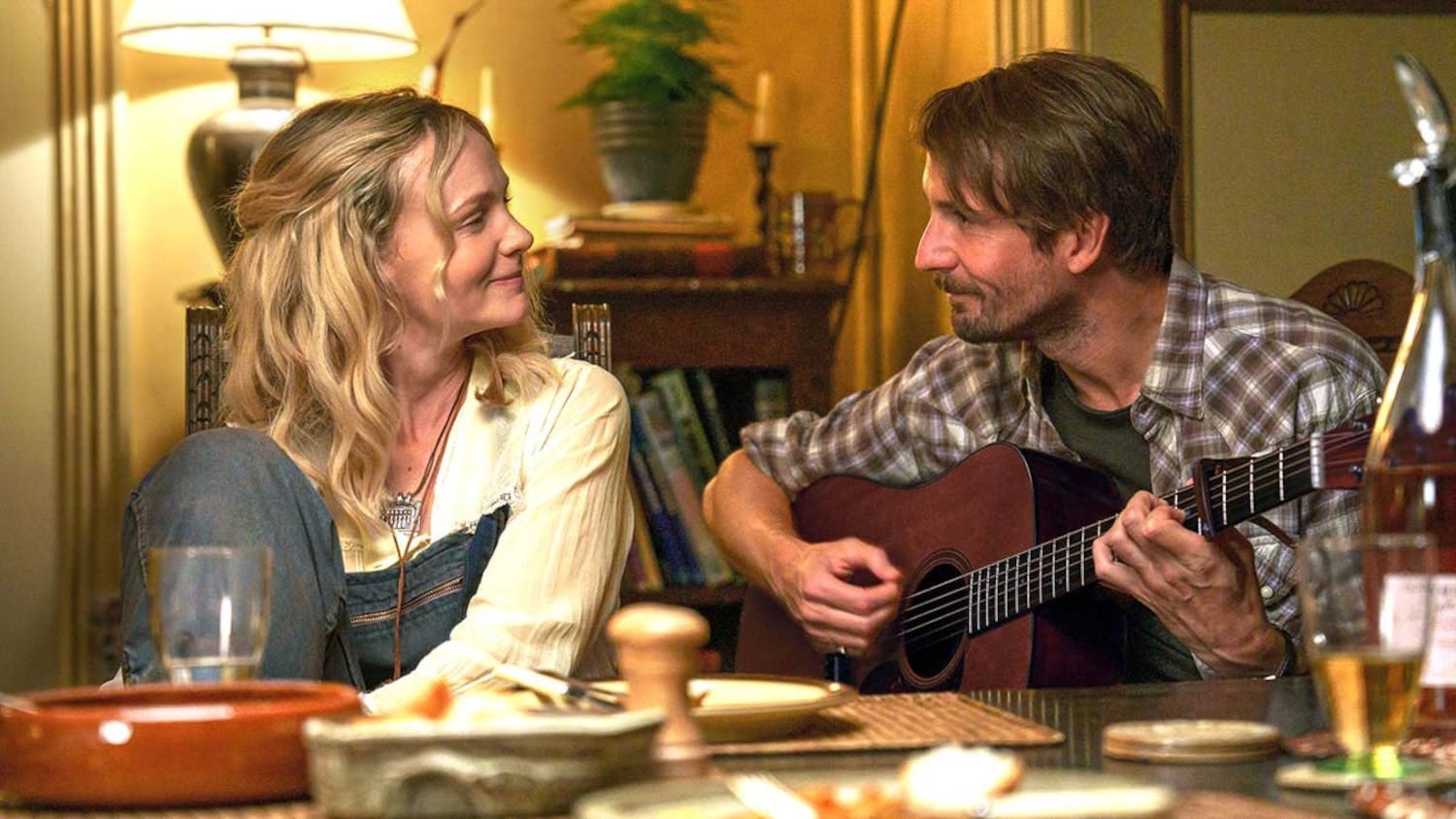
To do so, Charles has arranged an improbable reunion between two former folk music mega stars (and lovers), Nell Mortimer and Herb Maguire, whose shared musical past still lingers, unfinished, on the island. Their music was Marie’s favorite, and in bringing it back to life, Charles is not chasing nostalgia so much as he is offering thanks.
From a sacramental perspective, this is deeply Catholic. Marriage is not erased by death; it is transformed. Charles’s fidelity to Marie does not trap him in grief. Quite the contrary, it enlarges him - quietly opening the possibility of new affection, new joy, new friendships, and new life.
When Beauty Is Asked to Save Us
Herb’s relationship to the past is far more brittle. He snaps that he will not “play the old songs like some tribute band,” only for Charles to soften the moment with a gentle jab: “Tribute to yourself band, though.” The line is humorous, but it exposes a deeper fear - that the past might define Herb because he has not yet learned how to bless it.
When Herb and Nell play together again, the music is undeniably beautiful. One lyric captures this perfectly: “Outside it’s July, my head’s in December.” It is a stunning line, and a rather dangerous one. Because Herb wants the beauty of the music to justify undoing time.
St. Paul anticipates this confusion in his great hymn to love in 1 Corinthians 13. Written not for romantics but for a fractured community, Paul insists that giftedness without rightly ordered love becomes noise. “If I speak in the tongues of men and of angels, but have not love, I am a noisy gong or a clanging cymbal.” The problem is not the gift. The problem is asking the gift to do all the work for us.
Music in The Ballad of Wallis Island functions almost sacramentally. It reveals truth and works to mediate its presence. It exposes desire but the film is careful in doing so: music can console and reconcile, but it cannot replace commitment. Herb tries to make the music bear the weight of a life it was never meant to sustain. Charles understands what St. Paul insists upon: beauty must be received, not possessed.
Love Rejoices in the Truth
Nell understands this instance as well, even when Herb struggles to live it. Tellingly, the line comes not in an argument with her, but in a moment of exasperation directed at Charles, who keeps playing the old songs in the background (again and again) while they are all together. “Please, just stop playing our music, like, all the time,” Herb exclaims. It lands less as accusation than as confession. He knows, at some level, that the constant replay has become a way of refusing the truth of the present.
Nell does not need to respond. She is already living forward - married, with child, rooted in what is real. In this sense, she embodies what St. Paul means when he says that love “rejoices in the truth.” Here, the truth is spoken by Herb, but it is carried (quietly and steadily) by Nell. Her love has taken a particular, binding form. It is not coldness, but fidelity.
Joy, Laughter, and the Sound of Heaven
Yet, this film is genuinely funny. Charles’s earnest absurdities (“Kate Bush came to the island… more as a retreat,” he explains solemnly) and his baffled tenderness (“Don’t suddenly go swimming, man, in your underpants”) produce laughter that is affectionate rather than dismissive. My wife and I laughed, literally out loud! However, that same laughter was also followed by silence, a glance, or a tear.
C.S. Lewis helps us understand why this matters. In The Screwtape Letters, Lewis distinguishes between kinds of laughter and insists that “Joy” (the laughter of shared delight) is the one Hell cannot endure. He links it explicitly to music, which “smacks of heaven,” an echo of a reality demons cannot stand.
That is precisely the laughter this film evokes. A laughter that does not deny pain or rush past it, but allows joy to surface where love is wounded, honest, and still alive.
Love That Remains
Late in the film, Herb sings a line that functions almost as a confession: “Gotta move on / Stop chasing something I don’t want.” Based on my re-watch, this is not a triumph, but a surrender. St. Paul ends his own hymn to love by reminding us that faith, hope, and love abide, but love remains the greatest. Faith looks backward. Hope looks forward. Love lives truthfully in the present as it is open-handed, vulnerable, and free.
The Ballad of Wallis Island is not a story about starting over. It is a story about learning how to love after love - faithfully, truthfully, and with joy. And that joy, found in laughter, in music, and in the quiet grace of marriage, still smells faintly of heaven. In that sense, the film feels less like a feast-day story than an Ordinary Time one - content to let love grow slowly, truthfully, and without shortcuts.
It is worth noting, too, that had this film named God explicitly, it likely would have lost much of its audience. Many modern viewers do not first approach truth through argument or assertion, but through beauty - through story, music, and human vulnerability. The Ballad of Wallis Island understands this instinctively. It draws viewers in not by proclamation, but by via pulchritudinis, allowing meaning to emerge through tenderness rather than insistence. Even the film’s quiet conclusion reflects this logic. Herb finally relinquishes the persona that has held him captive and returns to his given name: Chris Pinner. In Scripture, name changes often mark moments of truth and return (Abram to Abraham or Simon to Peter). Here, the movement is not toward reinvention but recovery: not becoming someone new, but becoming oneself again. The film does not announce conversion, but it portrays something just as human and just as biblical) - a return to what is real.
I suspect I will keep noticing new details each time I return to this film: the persistent wetness, the food pressed into reluctant hands, the way hospitality keeps interrupting solitude. Nevertheless, that, too, feels right for a story about love that refuses to stay contained.
To Begin 2026
So my recommendation to start 2026: The Ballad of Wallis Island. Watch it with someone you love (or simply on your own) and let yourself laugh aloud. Then get the soundtrack and keep listening, allowing the music to keep working on you.
We need stories like this, in the Church and beyond it: stories that honor love without sentimentalizing it, that make room for grief without surrendering to cynicism, and that allows true joy to emerge. Wallis Island is not a “church movie.” It doesn’t need to be. It works because it trusts the audience, and because it reminds us, quietly and humanely, what love looks like when it is allowed to mature.
In a moment when both faith and culture are tempted either to harden or to overperform, The Ballad of Wallis Island reminds us that love deepens not by force, but by patience. A patience guided by faith, by hope, and (most importantly), by love.
Link to National Catholic Register article here: https://www.ncregister.com/commentaries/towell-the-ballad-of-wallis-island